Thursday, June 11, 2015

God stirs the heart of his people to support those he has committed to proclaim the gospel (Ex 35:21, 1Cor 9:14)

And everyone whose heart stirred him and everyone whose spirit moved him came and brought the LORD's contribution for the work… that those who proclaim the gospel should get their living by the gospel. (Ex 35:21, 1Cor 9:14)
Note the correlation of the “heave” and “wave” offering found in Ex 35:21-22 and Paul’s contextualization of the Levites to full time Christian workers in 1 Cor 9:13-14.
In Ex. 35:21 we find a parallel to A. God “lifting or stirring the heart” and giving a contribution that is lifted to God (through the "heave" offering) and B. God moving the spirit of individuals (:21) to give an offering (:22); specifically designed to sustain God’s servants (through the "wave" offering).
A. :21 The Hebrew word for a “heart stirred” אֲשֶׁר־נְשָׂא֣וֹ literally means that the heart is “lifted up” in worship.
The Hebrew word “contribution” אֶת־תְּרוּמַ֙ת (terumah) has been identified as a “heave offering,” where a portion of the wave offering is heaved or “lifted” off and is waved up and down signifying that God is Lord of heaven. It was given to the priests “for the tent of meeting, and for all its service, and for the holy garments."
As God lifts our hearts, we lift or “heave”, a portion of our gift to consecrate to God for worship!
B. :21 The Hebrew word for “moved” נָדְבָ֙ה literally means to: incite, impel, make willing.
The Hebrew word for offering תְּנוּפַ֥ת (Tenuphah) in :22 is the word translated for the wave offering, and refers to the whole of the offering that the terumah, or heave offering, is taken from. It is waved horizontally before the Lord, signifying that God is Lord of the earth, and was given to sustain the physical needs of the Levites.
As our hearts are lifted in worship, our spirit is moved to give a gift to sustain those He has called and set apart for ministry.
A few important takeaways:
1. Note the giving of the heave and wave offerings were to be a voluntary heart response to God who moved their spirit to give. This was an offering, not a tithe, ie: above and beyond, and not limited to a 10% system, based on the need.
2. The offering was given in the context of worship.
3. The same God that stirred the heart to give, provided the resources for the offering.
4. Paul applied the principles of giving to sustain the Levites to the support of full time Christian workers in 1 Cor 9:13-14, While he waved his right to receive gifts from the people he was ministering to as they were not yet mature in the faith, he did apply this principle from established mature churches who partnered with his ministry, like missionaries do today. (RH)

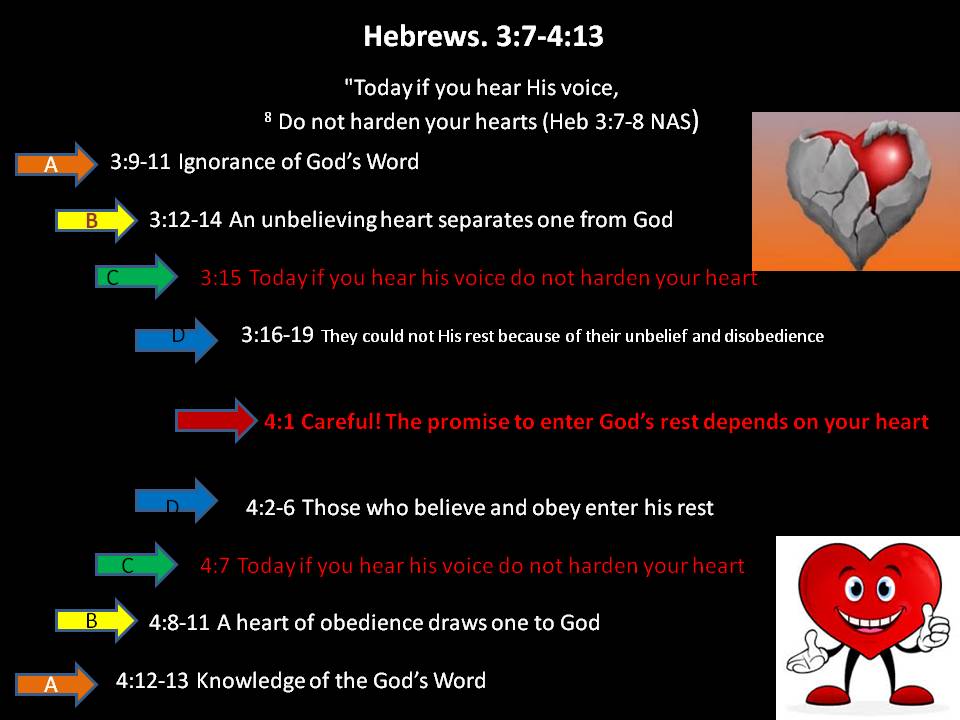
If you hear God's voice, do not harden your heart Chiastic structure of (Heb 3:7-4:13)

a Chiastic Structure in Hebrews 3:7-4:13. I wanted to introduce this concept early in our study as an illustration of the importance of how context, structure and especially literary structure can help in our understanding of Heb 4:12.
First note the general context that reveals the direction the author of Hebrews is going.
Chapter 1 The supremacy of Christ over Creation;
Chapter 2 the supremacy of Christ over the Angels;
Chapter 3 the supremacy of Christ as our High priest, (over Moses) and the promise of Sabbath rest.
This is a nice western outline showing the linear progression of thought that gives us an idea what is happening up to and including Hebrew 4:12 in relation to the important role of the Word of God and how it is used in our Spiritual growth (5:11-14).


There is yet another layer: the author of Hebrews writes in a Chiastic structure throughout this book that serves to weave together the linear concepts we have identified that tie together these concepts into relationships that serve to emphasize the direction of a main point in the passage.
1. In a Chiasm, the main point is in the middle instead of the end.
2. The structure then highlights specific thoughts or truths that come before and after that give thrust to the main point.
Our goal in this study is to discover the relationship between these thoughts and how they contribute to the main point.
In this example of a Chiastic structure, we mark the relationships with an arrow and a letter, and indent them to help them stand out (see diagram).


This helps us not only identify the relationships between the arrows, but also helps to surface the main point which is in the middle of the section rather than the end.
In the passage of Hebrews, relationships surface that contrast a hard and soft heart; Listening to God's voice through his Word, which lead to belief and obedience (cultivation a soft heart) in contrast to ignoring God's word, unbelief and disobedience (cultivating a hard heart).
Note the importance of listening to His voice, in 3:7, 15, and 4:7 and the relationship of listening to His voice to an understanding of His Word (3:9-11, 4:12-13),
This helps put Hebrews 4:12 into perspective in relationship to understanding how the word of God can help us discern the voice of God.
The relationship between the Word and the Spirit is what helps connects the Biblical passage to our personal lives. As we believe it, we apply (obey) it to our personal situation; Here God reveals to us what is behind our inner thoughts, motives and attitudes that can harden the heart.
If we do not listen to God's Spirit through his Word, His Word remains on the page, And His Spirit can get lost in the many voices of our subjective mind. If we shut out God's voice, our heart can grow hard, even in His presence, as it did to the Israelites in the wilderness.
The main point warns us to fear God (Heb 4:1) in how we deal with issues of the heart which can determine if we are to receive his Promise to enter into God's rest.
Remember the overall context is the Supremacy of Christ, and the importance of subjecting our will to His. While the heart wages war with the sinful nature of the soul, true peace can be found when we make Jesus Supreme through faith obedience to His Word
Well this is the gist of it. While one does not need to have all these "methods of Bible Study" to glean from God's Word, they can, when applied correctly, give us tools to dig deeper and confirm what His Spirit is saying to us.

God's voice in Discipleship (IS 50:4)

The importance of listening to God’s voice in discipleship.
Understanding Hebrew poetry, and the NASB translation help unlock the meaning of Is 50:4.
The Hebrew word לִמֻּד, (limmud) is listed twice in the verse identifying a Hebrew poetic structure drawing attention to two roles of the disciple: To listen to God’s voice and sustain the weary by teaching him or her God’s Word.
Note the parallelism in the two stanzas of AB and ABC;
A) The Lord God has given Me the tongue of disciples,
B) That I may know how to sustain the weary one with a word.
(the above is a poetic bicola or two lines that reflect an advancement in thought – He has given me the tongue (or word) to sustain the weary.
A) He awakens Me morning by morning,
B) He awakens My ear
C) to listen as a disciple.
(A Tricola, or a three line stanza reflects a climatic relationship, note the repetition of lines one and two that puts the emphasis on the third line on listening to God’s voice, which is why I reversed it in the summary statement above.
Both in the Old and New Testament God’s voice was communicated in the written and spoken word. The emphasis in this verse is on the prophet hearing the spoken word, ie: not in dreams or visions but in the waking hours.
I believe the NASB rendered a more accurate translation of the Hebrew word לִמֻּד, limmud as “disciple.”
The Hallot lexicon differentiates the definition in the NASB and the ESV which is translated as “taught”
—1. adj. taught, trained: with לִמּוּדֵי הָרֵעַ trained to do evil (Jer 13:23);
—2. pupil (ï תַּלְמִיד, (Is 50:4)
I tend to like the BDG lexicon which incorporates both
“taught, as disciples”.

Where does one look to hear God's voice?

Subject: Where does one look to hear God's voice? In His Word, to His Spirit, To other believers? A combination of the three? Some have suggested Luke 17:21 can provide an insight.
NIV/KJC "because the kingdom of God is within you"
NASB/ESV For behold, the kingdom of God is in your midst."
The translation hinges on the little Greek Word ἐντὸς (entos) that can be translated as "within you" or "in your midst" This word is only used twice in the NT, the other being in Matt 23:26, " "You blind Pharisee, first clean the inside of the cup and of the dish, so that the outside of it may become clean also." Here there is no question that it is translated "inside" or "within." The context in Luke 17 is even a little blurred as to the immediate audience, is it the Pharisees? or the Pharisees and the Disciples? And of course, how does Luke's Greek audience play into his word choice and what he is trying to say them. There is reason to believe that what Jesus is saying to the Pharisees is part of a larger lesson he is trying to convey to his disciples (see :22,and greater context of Luke, where Jesus uses his outward ministry as a method of teaching his disciples). So I decided to outline all 24 chapters of Luke in order to grasp the over all context to help me wrestle with this one little word ἐντὸς (entos)! I got to chapter 22 today in my study, and found a parallel passage to Luke 17:20-21 in Luke 21 (See below). Two interesting observations, (1) the location of the Kingdom seems to be connected with the coming or presence of Jesus. (2) There seems to be contradiction in the immediate context of Luke 17 and Luke 22 re: whether there are signs to be observed in the coming of the Kingdom.
"Now having been questioned by the Pharisees as to when the kingdom of God was coming, He answered them and said, "The kingdom of God is not coming with signs to be observed (Luke 17:20)"
31 "Even so you, too, when you see these things happening, recognize that the kingdom of God is near. (Luk 21:31)"
 I believe the answer to the above discrepancy of signs indicating the coming kingdom and the difference in translations regarding ἐντὸς (entos) regarding the location of the kingdom, are deeper than "either - or" answers, and that God is trying to say something more profound than I was looking for that will expand our understanding of the depth and riches of his Word! 

Saturday, September 28, 2013

Speak in the Spirit out of your identity in Christ


What does it mean to speak “by” or “in” the Spirit?
 καὶ οὐδεὶς δύναται εἰπεῖν· Κύριος Ἰησοῦς, εἰ μὴ ἐν πνεύματι ἁγίῳ. And no one can say, "Jesus is Lord," except by (or in) the Holy Spirit. (1 Cor 12:3)
While the context alludes to a confusion of spiritual gifts relating to speaking “in” or “by” the Spirit, Paul is clear in helping the Corinthians understand that only the Holy Spirit can testify to the Lordship of Christ. They could only speak "in the Spirit" through their relationship to the Spirit that is based on their identity in Christ.
The tiny prep. “en” when attached to the dative case is used here to mark “a close association within a limit" and helps translate the preposition as; "in" or "by". It  designates a close personal relation in which the referent of the ἐν-term is viewed as the controlling influence: under the control of, under the influence of, in close association with.” (BDAG lexicon)
Paul uses the prep.  ἐν to make clear that those who speak “by” or “in” the “Spirit of God”  refer to those who see their association with Jesus Christ as the controlling influence in their lives. In other words, those who consider Jesus as their Lord.
For those of us who have placed our faith in Jesus Christ, we share a personal relationship with Him that radically transforms our lives and identity. We are now “in Christ” and we live and speak on behalf of Jesus as our Lord and Savior. We live for Him and serve Him as our King. Our heart motivates us to spend time and money differently. We willingly release any rights to earthly possessions to see the gospel treasure go forth among the nations! The Spirit of God physically resides in us. To speak  “in” or “by” the Spirit,  is to speak out of our close association with the Spirit, as if He was speaking the same words through us. This is inspired speaking, where the words are Spirit breathed into us as we speak! This could be described as nothing less than a spiritual gift!
…. or is it that simple? Note Paul’s warning to the Corinthians; “I do not want you to be unaware…when you were pagans, you were led astray. (1Co 12:1-2 NAS)
Like the Corinthian church, we too come out of a specific cultural and spiritual context that can lead us astray. The adversary subtly shifts our focus and desires that make wrong seem… not so wrong, and what is right and true restrictive and narrow. Soon it appears to be fanatical to identify with God and Jesus Christ as our Lord and Savior. Sinful patterns of behavior call us deeper and deeper into the desires of the flesh and our identity in Christ can blur into doctrinal debates and a search for significance in the gifts, rather than the giver. Such fruit is identified with division, conflict, and a quest for spiritual power centered on the flesh.
God in his mercy has allowed us to suffer to remind us that the gospel treasure we share is centered on the person of Jesus Christ. When we grasp this, we will begin to seek to know him deeply in the fellowship of His sufferings (Phil. 3:10). We will desire to crucify our flesh (Gal 2:20) and be filled with His Spirit (Eph 5:18). We will want to base our identity in Christ. We will offer our bodies as living sacrifices and ask the Spirit to transform our minds anew (Rom 12:1-2! When we get to this realization, we will be able to  “speak by the Spirit”  in testimony to the Lordship of Christ in our lives. This would truly be a “spiritual gift” that is fit for worship.

Wednesday, February 6, 2013

Will a man rob God? How one's giving betrays their heart!


8 "Will a man rob God? Yet you are robbing Me! But you say, 'How have we robbed Thee?' In tithes and offerings. 9 "You are cursed with a curse, for you are robbing Me, the whole nation of you! (Mal 3:8-9 NAS)

 הֲ    (h¦) Interrogative particle. is prefixed to the first word of a sentence or a clause, mostly involving direct questions. When appears in a question that question is not asking primarily for information but rather is a rhetorical question to which usually a negative answer is expected. “Will a man rob God?” The implied answer would be “no” however the writer continues with “yet you do!”  Malachi is warning the priest and leaders of Judah that their tithes and offerings were not considered a voluntary contribution to God’s work. The tithe was a contractual agreement that dated back to the Passover in Exodus. On the night of the Passover, God sanctified the first born of every Hebrew family when the angel of death swooped down to kill the first born of all of Egypt in the final pleague before the Exodus.  When the angel of death came to a house that had the blood of the lamb painted over the door post it passed over and spared the son from death (Ex. 12:7,12-13). From that day forward every first born male was considered to be God’s possession. God had set them apart with the blood of the Passover lamb and they were now His (Ex 13:1)! Later God “called out” the tribe of Levi to take the place of the first born (Num 3:12-13).  In exchange every family was to give God a tithe (Num 18:21) to support those who took the place of their sons. By withholding the tithe, Israel was indeed “robbing God”. In response to this betrayal, God was about to judge Israel through famine 3:11, invasion, and captivity 4:1.
In relation to the word קבע that is translated “rob” the Halot lexicon has an interesting observation.
קֹבְעֵיהֶם congegated as a verb participle plural absolute has a disputed meaning. It either means “1. to walk behind one another (KBL); or 2. to rob, steal; The Sept. πτερυίζειν  (to betray) supports the first suggestion, in which case קבע would be an intentional alteration of עקב  . For Mal 3:8 the decision is difficult; within the context, ‘to betray’ is more acceptable than ‘to rob’”,  (HALOT Lexicon)

 The Septuagint (Greek translation of the Old Testament) helps clarify the disputed Hebrew meaning, by conveying the first hebrew meaning to “walk behind.”  Perhaps today one might say to go behind someone’s back… to betray.

 The context of the passage supports the idea of going behind God’s back, or disobeying him.  If this is correct, the verse might read “Will a man betray God?” The nuance of betrayal in ones understanding of disobedience brings a relational aspect to the sin. Betrayal implies the breaking of relationship, which seems to be more personal than breaking a law. The robbery noted in Malachi 3:8 is not just financial, and while the corruption of the priests and leaders of Israel may have yielded a short term gain, God was aware of the betrayal, and sent Malachi to warn them!

 Unlike Israel, the church today is not obligated by the Jewish law to tithe. Yet I wonder if, when we withhold our giving to God, there could be a nuance of betrayal?   The answer is both yes and no. For it is not the act of our giving that wins favor with God, but the motivation in why we give that pleases Him (2 Cor 9:7). There is a common thread that is woven throughout the Old and New Testament that is deeper than the law.  The law was given to Israel to bring a consciousness of their sin. (Rom 3:20; Heb 10:1-2), not salvation.  Ones relationship with God has always been measured through faith! (Gen 15:6, Rom 1:17, Hebrew 11). The seat of betrayal lies in the heart, not the wallet. Without God, the heart of man is deceitful and wicked! (Jer 17:9). God searches our hearts and tests us through our deeds (Jer 17:10)!  The Law was given as a measurement to Israel to enable them to see what God already has seen in their hearts! It is easy to miss the point and fall to the misperception that one's relatrionship to God is based on how one can or cannot keep the law. Even today some carry the misconception that their salvatoin is based on their works. When tempted to think this way, it is healthy remeber the wonderful truth that we are saved by grace, not by works! (Eph 2:8-9). Man looks on the outward appearance, but God looks at the heart (1 Sam 16:7).

 "As in water face reflects face, So the heart of man reflects man." (Pro 27:19 NAS). How one gives to the Lord, (motivation of heart, not the amount) reflects the heart of Man.

 Because the O.T. law was broken;

*Israel’s leaders sacrificed rotten food, blind and diseased animals to a holy God, ! (Mal 1:7-8,)
*Priests teaching did not teach word of God , but caused people to stumble in their walk( 2:7-8)
*Israel divorced their Jewish wives of the same faith, to marry women who worshiped other Gods (2:11-16)
*they withheld their tithes

Israel had betrayed God.
 
Taken in context, the withholding of tithes, was just one of several problems that reflected the heart of the leaders of Israel.

 Jesus said to those seeking to follow him;  “where your treasure is there your heart will be also” (Lk 12:34).

 God loves a cheerful giver because it reflects his/her heart and He will bless that person to enable him give generously (2 Cor 9:6-11).

 In answer to my above reflection; Yet I wonder if, when we withhold our giving to God, there could be a nuance of betrayal? My answer was both yes and no. No because we are not obligated under the law to tithe. And yes, becasue our heart betrays our motivation.  When one gives out of anxiety and fear, one may withold their giving, or even give extra in attempt to earn favor with God or men. When one gives to the Lord out of thankfulness, contentment, or even out of a healthy fear and reverence of who God is; he will give with a cheerful heart. God will know our heart and motivation in giving and promises is to bless those who give from a heart that reflects their love for Him. For God loves a cheerful giver! (2 Cor 9:7).

Saturday, February 2, 2013

the extraordinary quality of the power of God tranforms the whole person


7 But we have this treasure in earthen vessels, that the surpassing greatness (ὑπερβολὴ) of the power may be of God and not from ourselves; (2Co 4:7 NAS)

ὑπερβολὴ (surpassing greatness)
 
*excess, extraordinary quality or character 2 Cor 4:7 Gingrich
the extraordinary (quality of the) power 2 Cor 4:7 BDAG
*… metaphorically, superiority, excellence, preeminence (R. V. exceeding greatness): with a genitive of the thing, 2 Cor. 4:7; (Thayer)

If the abstract noun ὑπερβολὴ is rendered adjectivally, several appropriate words could “qualify ‘power’: 'transcendent,' 'extraordinary,' 'overwhelming,' 'preeminent,' 'incomparable.'" (Harris 341) The context implies  an emphasis on “quality” or “character” of  δυνάμεως (power) and creates a contrast to the earthenware containers. “Such vessels were regarded as fragile and expendable because they were cheap and unattractive. So the paradox Paul is expressing is that although the container is relatively worthless, the contents are priceless.” (Harris 340).

Not only does ὑπερβολὴ connote an idea of excellence, the superior quality of the power in contrast to the frail earthen vessel, elevates the character of the power to an even greater degree.

Unlike other passages that talk about the treasure in reference to the heart, Paul’s looks at the whole person as the receptacle for the soul, in which the treasure is housed (Harris 340). A couple principles that come out of the use of ὑπερβολὴ  include:

 *When the treasure of the gospel is housed in the soul, it affects the whole person!

*The quality or character of the power of God is so incomparable, preeminent, overwhelming, extraordinary and transcendent, in contrast to the power of man, that when one stands firm in his brokenness, his testimony will present a living gospel to those around him.